Orange Slice vs Apollo: Which is better for lead sourcing?
Feb 21, 2026

Orange Slice vs Apollo: Which is better for lead sourcing?
Orange Slice uses AI-powered web crawling to find high-intent prospects actively seeking solutions, while Apollo provides a 275M+ contact database with built-in sequencing for scale-focused outbound. Orange Slice prioritizes signal quality and timing through natural language workflow creation, whereas Apollo emphasizes volume and all-in-one functionality despite reports of outdated contacts affecting data quality.
TLDR
• Apollo offers the industry's largest B2B database with 275M+ verified contacts and 60M+ companies, plus integrated email sequencing and a generous free tier
• Orange Slice focuses on AI-driven intent signals rather than database size, scanning web sources to identify prospects actively looking for solutions
• Apollo users report bounce rates of 5-10% with some experiencing 30%+ for smaller companies, while Orange Slice prioritizes deliverability through live data verification
• Apollo costs $99/user/month for Professional tier with all-in-one capabilities; Orange Slice uses credit-based pricing focused on enrichment quality
• Choose Apollo for high-volume SMB outbound with North American focus; select Orange Slice for precision targeting and natural language workflow creation
• Both serve different GTM motions: Apollo starts with lists hoping for intent, Orange Slice starts with intent then finds matching contacts
Choosing the right lead sourcing platform in 2026 feels like picking between a massive warehouse full of contacts and a precision-guided system that hunts for buyers already raising their hands. Apollo offers a 275M+ contact database with built-in sequencing, while Orange Slice takes an agentic AI approach that scans the web for high-intent signals and pipes enriched prospects straight into your CRM.
The stakes are real. Teams are burning out on dirty data, wasted outreach, and tools that promise scale but deliver bounce rates that tank sender reputation. This post breaks down the Orange Slice vs Apollo debate using fresh research, so you can pick the platform that actually fits how your team works.
Why Compare Orange Slice and Apollo for Lead Sourcing in 2026?
Orange Slice is a GTM workflow builder and lead generation platform that lets teams create inbound and outbound go-to-market workflows using natural language. It acts as an agentic interface on top of existing GTM tools, enabling faster workflow creation, deeper automation, and the ability to answer niche, high-intent GTM questions that traditional tools struggle to handle.
Apollo has evolved from a simple contact database into what many call an "all-in-one" GTM platform, now boasting coverage of over 210 million contacts. It combines a massive contact database with sales engagement tools, making it a complete prospecting and outreach platform.
But here's the catch: Apollo's data quality has been flagged as inconsistent, with reports of outdated contacts creating friction for outbound teams. Meanwhile, Orange Slice focuses on surfacing prospects who are already showing purchase intent rather than simply expanding list volume.
Both platforms serve GTM teams, but they solve fundamentally different problems. Apollo prioritizes scale and bundled functionality. Orange Slice prioritizes timing and signal quality.
Contact Coverage: How Big—and Accurate—Are Their Databases?
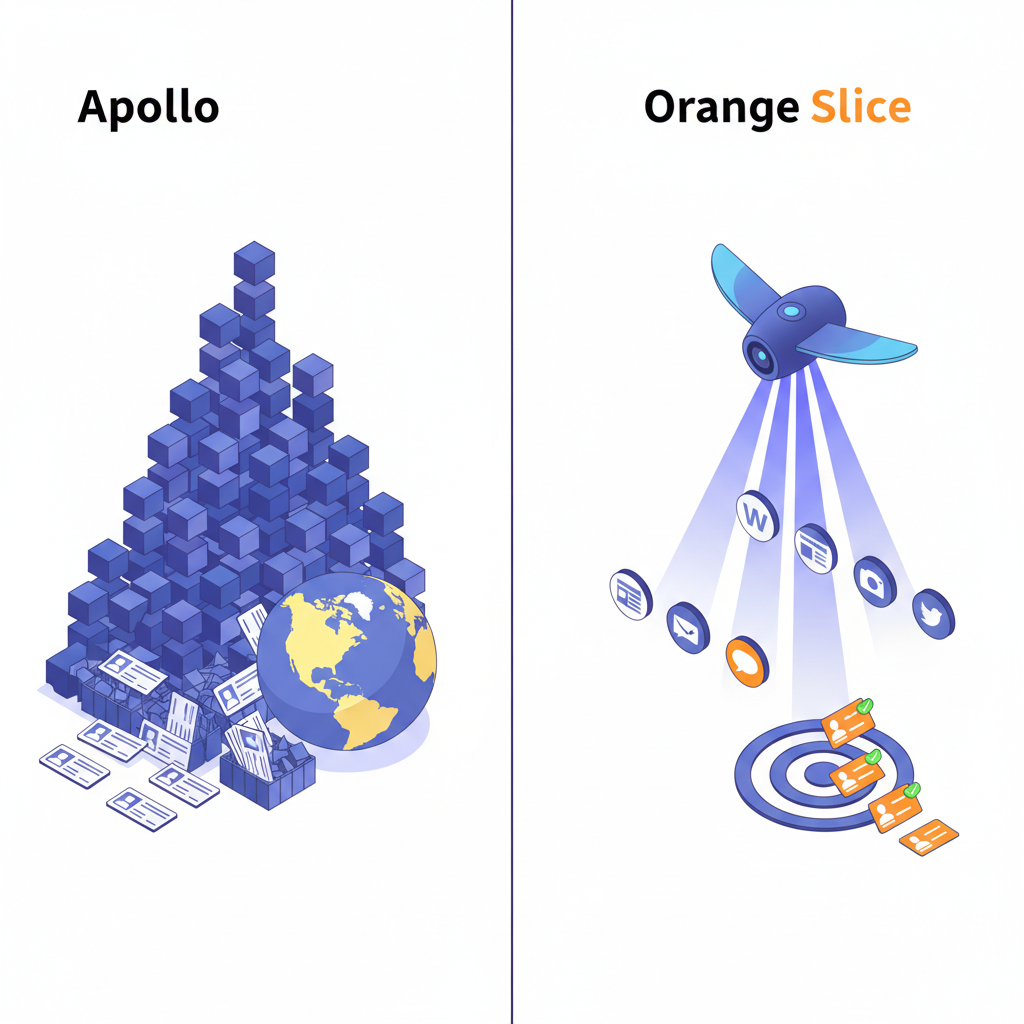
Apollo's database is genuinely massive. Independent reviews peg Apollo's coverage between 210M and 275M verified contacts, spanning nearly 60M+ companies. The platform offers over 65 advanced filters that let you get specific with firmographic and technographic criteria.
However, coverage drops significantly outside major Western markets. Less than 15% of Apollo's 275+ million contacts represent Asian professionals outside major tech hubs. If your ICP spans APAC or emerging markets, you'll hit walls quickly.
Orange Slice doesn't compete on raw database size. Instead, it uses custom scraping and crawling infrastructure to find high-intent prospects by scanning online data sources such as company websites, news articles, job postings, and social media. The focus is on signal quality over contact quantity.
Verified-email rate testing protocol
How accurate are these contacts when you actually try to reach them? Independent testing reveals meaningful differences.
Researchers built two testing environments to evaluate how providers perform across different business segments. In the SMB analysis, they compiled a dataset of 1,075 professional contacts. Enterprise testing expanded to 3,719 contacts to address enterprise-specific challenges like duplicate emails assigned to different people and mismatched domains across sub-organizations.
The scoring protocol used confidence-based metrics:
- 100% confidence: Positive response received from the contact
- 80% confidence: Email passed verification system
- 0% confidence: Email confirmed undeliverable
This matters because traditional email verification tools often miss catch-all and junk emails, which can make up to 50% of lead lists. The difference between claimed accuracy and real-world deliverability is where deals die.
Data Quality & Deliverability: Can Your Emails Actually Land?
Deliverability is where Apollo's scale becomes a double-edged sword.
Comparative testing shows that on average, valid email rates from verification-focused tools exceeded Apollo by 14-18%, depending on industry. Teams using Apollo often hit bounce rates of 5-10%, with reply rates stuck at 1-2%. Some users report even worse numbers: "Email bounce rates of 30%+ are common, especially for smaller companies."
Apollo's large scraped database introduces classification variability. Titles, functions, and seniority can shift between enrichment cycles, which wreaks havoc on routing, scoring, and persona logic. A "Head of Marketing" might become a "Marketing Lead" during a dataset refresh, throwing off your entire segmentation.
Orange Slice takes a different approach by pulling live data from multiple sources and using AI-powered columns that analyze multiple data points to make predictions. The platform monitors Reddit threads, Hacker News, and community forums to surface people actively looking for alternatives—with their contact info attached. This signal-first approach means you're reaching out when intent is highest, not just when a contact record exists.
Key takeaway: High-volume databases mean nothing if your emails bounce or land in the wrong inbox. Verify data quality before scaling outreach.
How Do Workflow Automation & Agentic AI Change the Game?
This is where the philosophical differences between these platforms become most apparent.
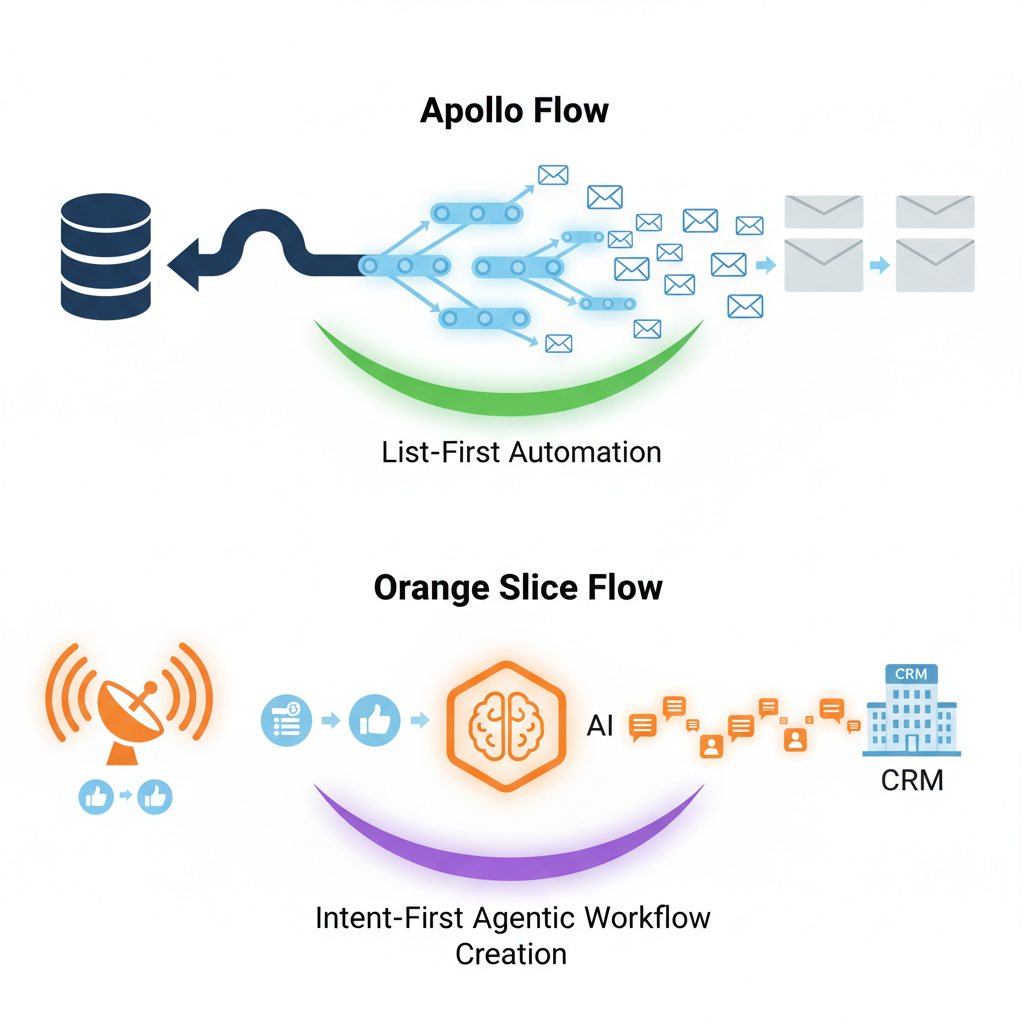
Orange Slice is built as an agentic interface that can "Scrape websites, monitor LinkedIn, enrich your CRM, build automated workflows, and research competitors—all on autopilot." The platform uses natural language to create GTM workflows, meaning teams can describe what they want and the AI figures out how to execute it.
Apollo has responded to the agentic AI wave with its own developments. In late 2025, Apollo announced the launch of its Agentic End-to-End GTM Platform, the first unified system where intelligent AI agents collaborate with sales and marketing teams to automate and optimize every stage of the GTM process. Over 10,000 users signed up for the beta within five days.
Apollo's Workflow Engine lets you build comprehensive workflows using multi-branch and conditional logic to create multiple pathways. It's powerful for teams that want to scale campaigns across territories and personas.
But there's a key difference in philosophy:
- Apollo's automation starts with its database and helps you reach more people from that list faster
- Orange Slice's automation starts with intent signals and helps you find the right people to reach in the first place
For GTM agencies that need to build and iterate workflows extremely quickly, Orange Slice's natural-language workflow creation offers a speed advantage. You describe what you need; it writes the code.
Pricing Models and ROI: Free Tiers vs Credit Pools
Apollo's pricing is designed for accessibility. Pricing is tiered (Free, then paid plans like Basic, Professional, Organization) with per-user fees and credits for data usage. Apollo's Professional plan costs $99 per user per month.
Apollo offers a permanent free plan with unlimited email credits (250/day fair use), though advanced features require paid tiers. This aggressive pricing undercuts most competitors—Apollo uses data as a "loss leader" to sell its software.
The ROI story is compelling on paper. Users report 4x more meetings booked and 50-64% reduction in sales tool expenses compared to traditional tech stacks. But these numbers assume your data quality is high enough to actually land those meetings.
Orange Slice takes a different approach to pricing, focusing on credit-based enrichment rather than per-seat costs. The value proposition centers on finding fewer, better leads rather than more leads at scale.
Here's the real ROI question: Would you rather pay less per contact for a massive list with variable quality, or invest more per contact for prospects who are already showing purchase intent?
When Should You Choose Orange Slice vs Apollo?
The right choice depends on your team's motion, data needs, and workflow complexity.
Choose Apollo if:
- You need a fast, all-in-one tool and can accept variable data quality
- Your team wants data plus outreach without stitching many tools together
- You're running high-volume SMB outbound motions
- You have a dedicated ops person who can manage sending limits and data hygiene
- Your ICP is primarily North American and Western European
"Apollo.io works well for many teams, but it's not the right fit for everyone. Whether you're concerned about data accuracy, overwhelmed by the learning curve, or just want to explore what else is out there," notes one industry guide.
Choose Orange Slice if:
- You care about cleaner data, better timing, and more personalized outreach
- Your team needs to build and iterate GTM workflows quickly using natural language
- You want to find high-intent prospects rather than simply expand your contact list
- You need an agentic interface that controls multiple GTM tools through APIs
- You're targeting niche markets or complex GTM questions that static databases can't answer
Pick one core outreach platform that matches your motion—avoid tool overlap. Some successful teams use both: Clay for high-value account research and Apollo for volume prospecting. Orange Slice fits into this ecosystem as the signal layer that identifies who to prioritize.
Key Takeaways for GTM Leaders
Apollo delivers scale. With 275M+ contacts and integrated sequencing, it remains the go-to for teams that want everything in one platform and can tolerate data inconsistencies. The free tier makes it accessible for testing.
Orange Slice delivers precision. Built as an agentic AI platform that scans for high-intent signals, it's more powerful and extensible than Apollo via direct API connectivity. For GTM agencies building complex workflows at speed, the natural-language interface changes the game.
The question isn't which platform has more contacts. It's whether you want to start with a list and hope for intent, or start with intent and find the contacts who match.
If you're tired of dirty data and want to focus on prospects who are already looking to buy, Orange Slice offers a fundamentally different approach to lead sourcing—one built for the agentic AI era.
Frequently Asked Questions
What are the main differences between Orange Slice and Apollo for lead sourcing?
Orange Slice focuses on high-intent signals and precision, using AI to find prospects already showing purchase intent. Apollo offers a massive contact database with built-in sequencing, prioritizing scale and bundled functionality.
How does Orange Slice ensure data quality in lead sourcing?
Orange Slice uses custom scraping and crawling infrastructure to find high-intent prospects by scanning online data sources. This approach prioritizes signal quality over contact quantity, ensuring cleaner data and better timing for outreach.
What are the pricing models for Orange Slice and Apollo?
Apollo offers tiered pricing with a permanent free plan and paid tiers for advanced features. Orange Slice focuses on credit-based enrichment, emphasizing fewer, better leads rather than more leads at scale.
When should a company choose Orange Slice over Apollo?
Companies should choose Orange Slice if they prioritize cleaner data, better timing, and personalized outreach. It's ideal for teams needing to build and iterate GTM workflows quickly using natural language, especially when targeting niche markets.
How does Orange Slice's agentic AI differ from Apollo's automation?
Orange Slice's agentic AI starts with intent signals to find the right people to reach, while Apollo's automation begins with its database to reach more people faster. This difference highlights Orange Slice's focus on precision and timing.
Sources
- https://growthlist.co/b2b-lead-generation-tools/
- https://scalelist.com/apollo-io-review-2026-is-the-all-in-one-giant-right-for-you/
- https://www.mailgo.ai/blog/apollo-outreach_125
- https://www.gruppointegritas.com/blog/asian-data-gap-hybrid-lead-generation-clay-apollo
- https://www.orangeslice.app/
- https://www.theplaybook.agency/post/clay-vs-apollo-the-2025-sales-leaders-comparison-guide
- https://growthhacksuite.com/apollo-io-vs-hunter-io
- https://www.salesforge.ai/de/blog/clay-vs-apollo
- https://genesysgrowth.com/tools/apollo-io
- https://pintel.ai/blogs/lead-enrichment-tools-compared-apollo-clay/
- https://www.apollo.io/magazine/redefining-how-companies-drive-revenue-in-the-ai-era
- https://www.apollo.io/product/workflow-engine
- https://www.seraleads.com/blogs/2026-guide-to-zoominfo-apollo-uplead-lusha-sales-navigator-hunter-io
- https://lagrowthmachine.com/best-apollo-alternatives/
- https://aitoolsbusiness.com/ai-sales-outreach-tools/
- https://orangeslice.ai